
Running a Sex Offender Check in Taylor County
The Georgia Violent Sexual Offender Registry is the first official channel. The Georgia Bureau of Investigation and Georgia Crime Information Center manage it under O.C.G.A. § 42-1-12. Taylor County Sheriff's Office registers people who reside in the county and sends updates to the state system. The public portal is free in the observed workflow and does not require an account.
Search with enough detail to distinguish people who have similar names. Then read the record's status, offense, location, and identifiers together. The registry changes often and does not guarantee accuracy. A missing result is not proof that no qualifying record exists. Wrong spelling, a different county, agency reporting lag, or a record no longer shown can all affect a search.
Taylor Registry Updates Start Locally
The Taylor County sheriff is the local registration office at 5 North Ivy Street in Butler. Call the jail at 478-862-5444 or the sheriff's nonemergency line at 478-862-5451 to confirm current hours, appointment needs, and any local procedure. The research found no published local appointment schedule or fee, so verify those details before traveling.
Georgia law directs the sheriff to update supplied registration information within two business days. GBI updates the central registry daily. That chain explains why the sheriff is the right office for a Taylor address concern, while GBI operates the public database.
The county office is also the best place to ask whether a recently supplied change has entered the state workflow. Public users should not demand private registration documents. Ask staff to verify the public status or correct the statewide display through official channels.
Searching the Georgia Sex Offender Registry
The portal opens behind conditions of use and a CAPTCHA. GBI confirms that name and county searches are available after the gate, but the CAPTCHA prevented a responsible field-by-field inspection. Use only the controls the live portal presents. Do not assume there is a radius search, map filter, or alert signup.
- Open the official registry and read the conditions of use.
- Select “I agree,” complete the CAPTCHA, and continue.
- Enter a name or select Taylor County using the controls shown.
- Compare the returned identifiers and open the relevant public profile.
| Search item | Type | Required | Notes |
|---|---|---|---|
| Conditions acceptance | Buttons | Yes | Choose “I agree” or “I do not agree.” |
| CAPTCHA code | Text | Yes | Complete before continuing. |
| Name | Search control | Optional | Confirmed by GBI FAQ; exact subfields may change. |
| County | Selection | Optional | Select Taylor for a county-focused search. |
GBI's Registry Access Gate
The official search screen shows the conditions, CAPTCHA, and continue controls before any public results.
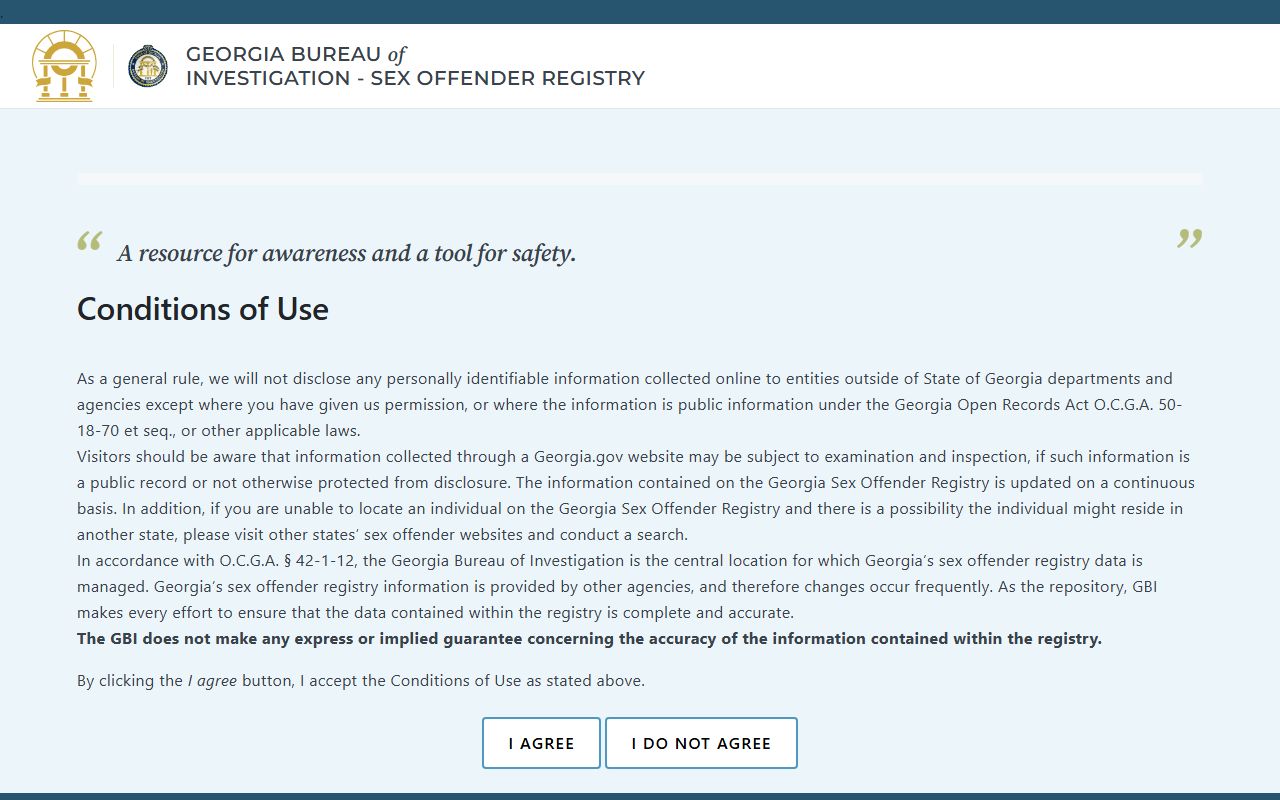
This gate matters because it requires users to accept the lawful-use terms before viewing Taylor County registry records. It also means no unverified search fields should be promised.
The registry says its information changes frequently and carries no accuracy guarantee. Treat each match as a lead for careful review. Confirm a questionable Taylor address with the sheriff rather than confronting anyone listed.
What a Registry Profile Shows
Georgia law requires sheriffs to collect a broad set of data, but the current public profile may show less. Statutory collection includes names, physical description, photograph, fingerprints, date of birth, residence or sleeping location, school, workplace, vehicles, online identifiers, offense details, and release or supervision information. Some of that data is protected or absent from public view.
| Identity | Names or aliases, photograph, sex, race, age, and physical description where displayed. |
|---|---|
| Appearance | Height, weight, hair, eyes, and scars, marks, or tattoos where displayed. |
| Location | Reported address, county, map, work, or school information when publicly provided. |
| Offense | Offense, statute, conviction date, jurisdiction, and victim category where shown. |
| Status | Registration status and classification supplied through the local and state process. |
The CAPTCHA blocked a current public-profile inventory, so these are common schema categories, not a promise that every field appears today. Never infer a missing private detail from a blank public field.
Taylor Collection Versus Public Display
The distinction between sheriff collection and public display protects against two common errors. First, a profile is not the complete file held by the sheriff. Second, the absence of a data point on screen does not mean the sheriff never collected it. Social Security numbers, fingerprints, and online identifiers may support administration without appearing as public search details.
The GBI registry program page explains the statewide system and the sheriff's reporting role.
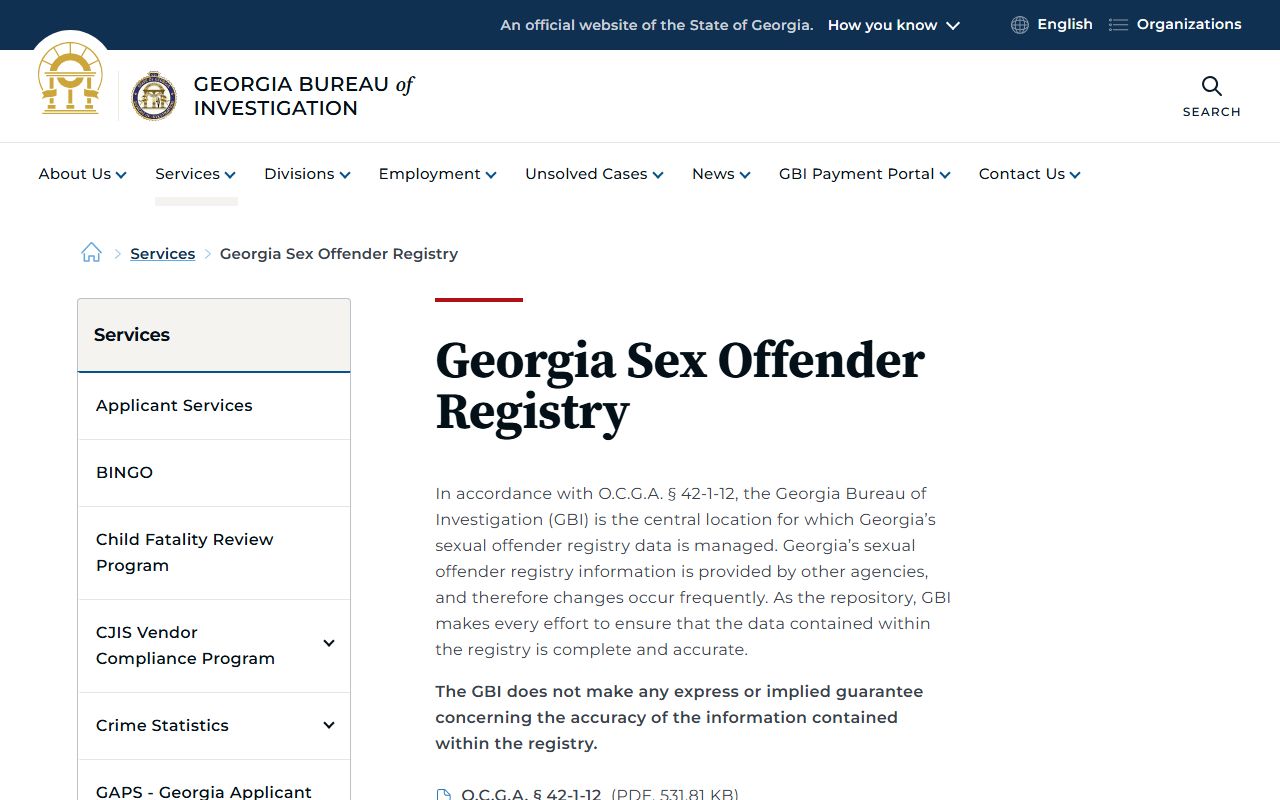
This state overview is the better source for program rules, while the search portal is the better source for current public entries.
Registration Requirements and Levels in Georgia
Georgia does not use a public Tier I, Tier II, and Tier III system with fixed 10-year, 25-year, and lifetime terms. Its classifications are Level I, Level II, and sexually dangerous predator. Registration is generally for life unless a court grants release through a statutory route. A classification describes assessed risk and legal duties, not a new conviction.
| Classification | Duration | Verification |
|---|---|---|
| Level I | Generally life unless a court releases the person | Annual birthday cycle |
| Level II | Generally life unless a court releases the person | Annual birthday cycle |
| Sexually dangerous predator | Generally life; lifetime GPS applies | Birthday plus six months later |
A registrant generally must report in person within 72 hours after release, entry into Georgia, or a covered change, and renew within the 72 hours before a birthday. A petition for removal under § 42-1-19 goes to the conviction Superior Court, or the residence court for an out-of-state conviction, and depends on statutory eligibility.
Georgia's Date-Specific Distance Rule
Georgia's 1,000-foot provision in O.C.G.A. § 42-1-16 is not a simple rule for every registrant. The cited section addresses acts committed from July 1, 2006, through June 30, 2008, identifies certain child-centered locations, and contains grandfather provisions. Readers should check the person's controlling law and any court orders rather than applying the distance figure to all Taylor County profiles.
This date limit is vital. Flattening the statute into a universal ban can misstate both the law and a person's status. The GBI explanation of § 42-1-16 provides the official starting point.
Pair Taylor Searches with NSOPW
A Taylor County filter only addresses records associated with this county in Georgia's system. If a person may live, work, study, or travel elsewhere, search the U.S. Department of Justice's National Sex Offender Public Website. NSOPW draws from participating jurisdictions and remains dependent on their data and update schedules.
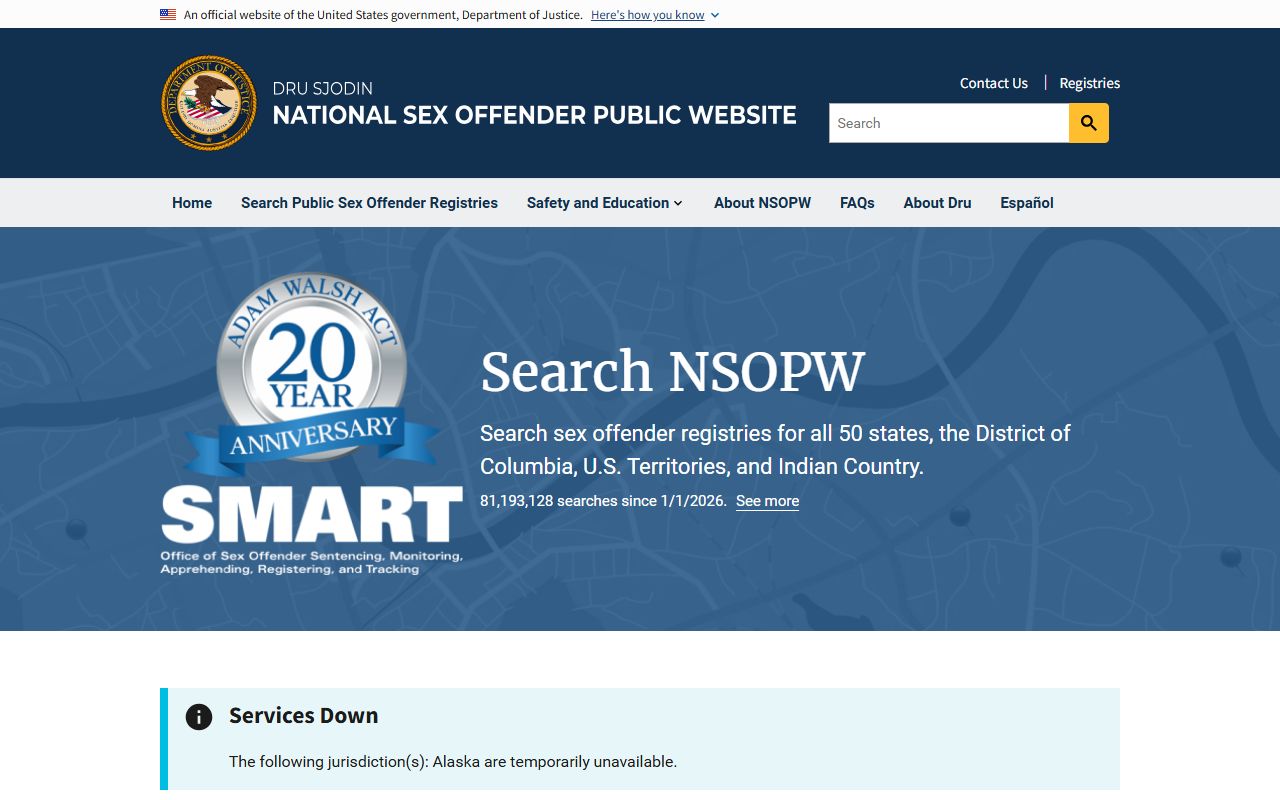
The national layer broadens the geography but does not replace Georgia's registry or Taylor County verification. When sources differ, compare update dates and contact the agency responsible for the reported address.
When a Taylor Address Looks Wrong
Do not visit the address or approach the person. Report a suspected wrong Taylor County address to the sheriff at 478-862-5451. Information about a residence in another Georgia county belongs with that county's sheriff. GBI also provides an online tip channel.
Give the agency the profile name, displayed address, and the reason the listing appears wrong. Avoid publishing assumptions. False reporting or failure to comply with registration duties is a felony under § 42-1-12(n), but only authorities can investigate whether a violation occurred.
Preserve the exact page address and the date you viewed it. Those details help staff distinguish a stale display from a different person or location. If the issue presents an immediate threat, call 911 instead of sending a routine tip. A registry correction can require the residence sheriff to check facts and pass an update through the state system, so the public screen may not change at once.
Lawful Use and Community Notification
Registry information supports community awareness and practical safety planning. It does not authorize harassment, threats, trespass, vigilantism, or discrimination outside what the law permits. Use the official record to learn, confirm location questions with the proper agency, and call 911 for an immediate danger.
Use registry information lawfully: O.C.G.A. § 42-1-12 warns against misuse. Harassing, threatening, or intimidating a registrant or household member based on registry information can lead to criminal penalties. Report concerns to law enforcement and do not confront anyone.
The registry is one public-safety source, not a measure of every offense or person who may pose risk. Sound community planning uses ordinary precautions alongside official information.
A careful review separates an offense description from a present claim about conduct. Read the conviction jurisdiction and date, classification, and current status as distinct fields. Do not recast a profile into a broader allegation. Families can use verified locations to discuss boundaries, travel plans, and whom to call, while still respecting lawful access to homes, work, and public space.
For printed or saved results, note when the search was run. Registry information can change after a move, new report, court order, or agency correction. Return to the live Georgia portal before relying on an older copy, and use NSOPW when the search needs to reach beyond Taylor County.